
Derivatives are often seen as the most complicated corner of financial markets. Many new traders hear the terms futures and options and immediately feel overwhelmed. It is easy to understand why. These instruments involve predictions, contracts, and plenty of risk. Still, they exist for a reason. Derivatives help traders and institutions manage uncertainty and protect themselves against unexpected price movement. And with the rapid growth of digital assets, more people are encountering these market tools for the first time.
The aim of this article is simple. It explains what futures and options are in a way is easy to understand. It also highlights the risks involved, because derivatives can cause serious losses when used without caution, and proper risk management. By the end, you should understand what these instruments do, how they work, and why traders use them. You will also know the most important risk mechanics to consider before ever using them in a real trade.
This is not a technical manual. It is a practical, beginner friendly guide that teaches the essential ideas without drowning you in jargon.
Understanding Futures Contracts
A futures contract is an agreement between two parties. The agreement states that one person will buy a specific asset at a specific price on a specific date. The other person must sell that asset under the same conditions. Everything is set in advance. The price is fixed. The date is fixed. Once you enter the contract, you are committed.
Imagine two friends who both follow the price of gold. One believes the price will rise in the next month while other believes it will fall. They decide to create a simple contract. Friend A agrees to buy one unit of gold from Friend B for a fixed amount on an agreed date next month. If the price rises above their agreed price then Friend A makes money. If the price falls, Friend B benefits instead. They both locked in a price today for a transaction that will take place in the future. That is the basic structure of a futures contract.
These agreements are recorded and managed by exchanges in real markets. You do not need to actually deliver or receive physical items when using futures in crypto markets. You are only dealing with price differences, but the logic remains the same.
Why People Use Futures
Traders rely on futures for two main purposes.
One is speculation. A trader might believe the price of Bitcoin or Ether is going to rise. Instead of buying the asset directly, they can open a futures position that pays them if their prediction is correct. If the market moves in their favor, they profit. If the market moves against them, they lose.
The second purpose is risk protection. A miner or long term holder of an asset might worry about a possible price drop. To protect themselves, they can use futures to lock in a price. This way, they do not suffer as much if the market falls sharply.
Both approaches sound reasonable, but they come with serious risk. That risk becomes more intense when traders use something called leverage.
The Dangers and Appeal of Leverage
Leverage allows you to control a much larger trade with a small amount of money. For example, a trader with ten dollars might be able to open a futures position worth one hundred dollars. This makes every little price movement feel ten times stronger.
When the market moves in your favor, leverage can increase your profit. When it moves against you, the losses come faster than most new traders expect. In extreme cases, you can lose your entire account balance in seconds.
This is why experienced traders treat leverage with respect. It is a powerful tool, but it is also one of the fastest ways to destroy capital if you are not prepared.
Perpetual Futures and Funding Payments
In traditional markets, futures contracts have an expiration date. Crypto introduced something different called perpetual futures. These contracts never expire. Traders can hold them for as long as they want, as long as they do not run out of money.
To keep perpetual futures aligned with the real market price, exchanges use something called funding payments. This system encourages traders to keep the futures price close to the actual spot price. When the futures market is trading above the spot price, longs pay shorts. When it is below, shorts pay longs. These payments can add up over time, which is another hidden risk for new traders.
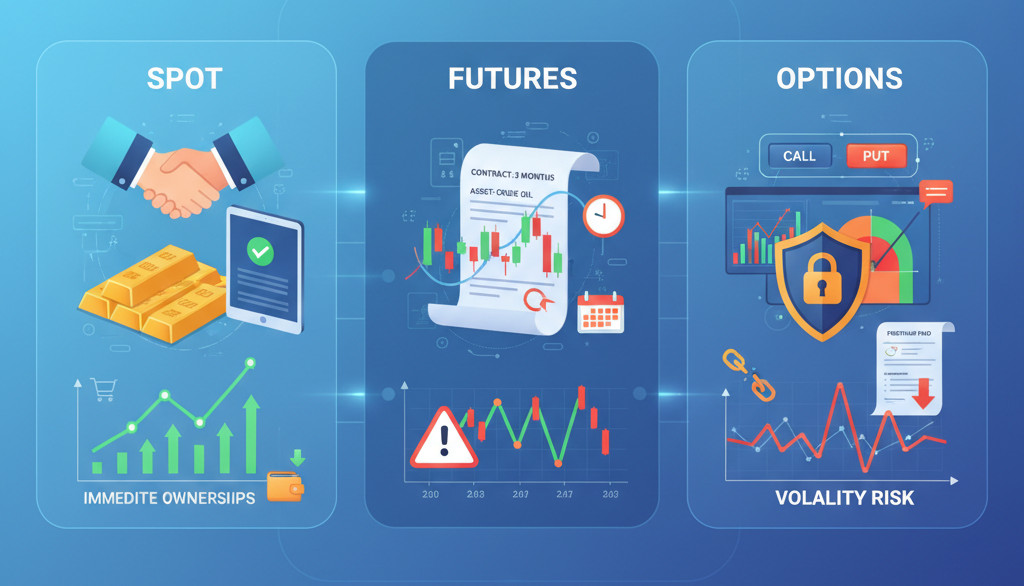
Futures, Options, and Spot Trading: Understanding the Difference and Why Many Beginners Prefer Spot
Before diving too deeply into derivatives, it helps to understand how they compare to simple spot trading. Spot trading is the most straightforward way to interact with any asset. When you buy on the spot market, you immediately receive the actual asset in your account. You own it directly. This gives you full control. You can hold it, transfer it, sell it, or move it to a wallet whenever you want. There is no contract, no expiration date, and no hidden funding payments. It is simply ownership.
This is very different from futures and options. With futures, you are trading a contract that represents the asset rather than the asset itself. You never need to touch the real asset. Instead, you are agreeing on a future price. The movement of the asset affects your profit or loss, but you never own anything physically or digitally. This creates exposure without ownership, and although it can lead to gains, it also increases risk because of leverage and liquidation.
Options are also contract based. When you buy an option, you are purchasing the right to buy or sell an asset at a set price. But again, you do not actually own the asset unless you choose to exercise that right. This means you are dealing with probabilities, premiums, and timing, rather than direct ownership.
Spot trading avoids these complexities. It gives beginners more control because the asset is theirs. If the market becomes unstable, they can simply hold until conditions improve. If they want to leave an exchange for safety, they can transfer the asset to a personal wallet. If they decide to cash out, they can sell instantly without worrying about liquidation levels or time decay.
This freedom is why spot trading is usually recommended for newcomers. It teaches market behavior without exposing them to the advanced risks that come with derivatives. Once a trader understands how prices move and how markets behave, they can explore derivatives with a stronger foundation. Spot trading is the safest entry point because it combines simplicity, flexibility, and full ownership.
What Options Are and How They Work
If futures feel too strict, options offer a more flexible alternative. An option is a contract that gives you the right to buy or sell an asset at a specific price before a set date. You have the choice to act on the contract or ignore it. You are not forced to complete the transaction.
There are two main types of options.
Call options give you the right to buy at a set price.
Put options give you the right to sell at a set price.
To receive this right, you pay a small fee called a premium. Once that is paid, the rest depends on what the market does.
Simple Example of a Call Option
Imagine you think Ether will rise above two thousand dollars next month. Instead of buying Ether today, you buy a call option that allows you to purchase it later for two thousand dollars. If Ether becomes worth two thousand five hundred, you have the right to buy it at the cheaper price. This is valuable, and you can profit.
If Ether never rises, you do not have to do anything. Your only loss is the cost of the option premium.
This flexibility makes options attractive, especially for beginners who want a limited risk approach to speculation.
The Purpose of Options
Options are used for three main purposes.
Protection. A long term holder who fears a price drop can buy a put option. If the market crashes, the put option gains value and reduces their overall loss.
Speculation. Traders who want to express a view about direction, timing, or volatility can use options to make sophisticated predictions.
Income generation. Some traders sell options to collect premiums from other traders. This can be profitable, but it carries significant risk if the market makes a sharp move.
Important Risk Mechanics Every Trader Should Know
Understanding the structure of futures and options is only half of the story. The real challenge is managing the risk they bring. Derivatives amplify both gains and losses, so traders must know what they are dealing with.
Below are the most important risk mechanics to understand.
Leverage Strengthens Everything
As mentioned earlier, leverage increases the power of price changes. A one percent move can feel like ten percent or more. This is exciting for new traders, but it is also dangerous. Even professional traders rarely use high leverage, because the downside is too sharp and too sudden.
If you ever choose to use leverage, do so with very small amounts and a clear stop loss plan.
Volatility Can Change Everything
Crypto markets are known for their rapid price swings. Volatility affects both futures and options. In futures, it creates sudden liquidation events. In options, it changes the premium you pay or receive. A market with high volatility will make options more expensive, even if the price itself stays the same.
New traders often buy options during periods of extreme excitement. They think the market will explode in a certain direction. What they fail to notice is that the premium already reflects this expectation. As a result, they lose money even when the market moves slightly in their favor because the option was too expensive from the start.
Time Decay in Options
Options lose value over time. Every day, a small part of the option premium disappears. This is known as time decay. The effect becomes stronger as the expiration date approaches. If the market does not move quickly enough, the option will lose value even if your prediction was correct.
This is why many new traders struggle with options at first. They might guess the right direction but still lose money due to the passing of time.
Funding Payments in Perpetual Futures
As explained earlier, perpetual futures come with funding payments. Over several days or weeks, these payments can reduce profit or increase losses. Funding is often ignored by beginners, but it plays a major role in long term positions.
Liquidity and Slippage
A market with low liquidity can make it difficult to enter or exit trades at the price you want. The difference between the price you expect and the price you get is known as slippage. In fast markets, slippage can be significant. It might even turn a profitable idea into a losing trade.
Why Learning Derivatives Matters Even If You Never Trade Them
You do not need to actively trade futures or options to benefit from understanding them. These markets influence the price behavior of major assets. They affect volatility, momentum, liquidity, and market structure. When you understand how derivatives work, you see the market with more clarity.
You start to recognize why certain price movements happen. You become aware of liquidation cascades, funding cycles, and volatility squeezes. Even if you stick to simple spot trading, this knowledge helps you avoid risky moments and spot better opportunities.
Final Thoughts
Futures and options are powerful financial tools. They help traders protect their portfolios, test trading ideas, and navigate uncertain markets. They also carry serious risk, especially when used without proper knowledge. The most successful traders approach derivatives with respect, patience, and a clear plan.
If you are new to these instruments, start by learning the concepts. Practice with small amounts. Never rely on high leverage. Focus on risk management before thinking about profit. Derivatives are not shortcuts to quick gains. They are advanced tools that reward patience, discipline, and a calm mind.
Once you understand the mechanics and the risks, futures and options become less intimidating and more practical. They can help you make smarter decisions, whether you are actively trading or simply trying to understand how the market behaves.